


A living from land and water.
It began at the pond bank. MAACH is for everyone whose income comes out of the water, the field, the forest or the loom — work that is steadier, better paid, and counted as work.
माछ means fish. We started with fish farmers and kept the name, because the year turned out to be the same everywhere.
Everything here starts where the water is.
The pond. The channel that reaches the field. The stream the forest drinks from. The vat the dyer heats. Four kinds of work, one dependency — and the same shape of year underneath all of them: the money goes out first, the middle is a long wait, and what a family earns is settled in a handful of days at the end.
One line of water, four kinds of work.
Jal
जलFish farmers and pond and tank lessees — and the women who dry, carry and sell what comes out of the water.
Opens first · 10 July 2027Khet
खेतSmall and marginal farmers, and the families who do the work on land that belongs to somebody else.
After JalVan
वनHouseholds who live on what the forest gives — gathering, drying, grading, and selling it on.
After JalHunar
हुनरWeavers, potters and the hands that make things worth a good deal more than the maker is paid for them.
After JalThe year runs the same way for all of them.
A pond, a field, a forest and a loom. Different work, one calendar — and the same four moments in it.
First
The money leaves before anything arrives
Fingerlings, feed, seed, yarn, dye, the cost of getting to the collection point. Often borrowed, often at a rate nobody writes down, and always before a single rupee has come in.
Then
The long middle, where there is nothing to do but worry
The water warms or it doesn't. The rain comes early or late. The flowers drop. The order gets quieter. Four months of a household holding its breath and pretending it isn't.
In June every man in the village becomes a weather scientist. Only the pond keeps score.
Then
The few days that decide the whole year
The buyer arrives when the fish cannot wait, the grain is already cut, the mahua is already drying. The price is take it or leave it, because leaving it costs more than taking it.
Relatives find the way to your house very easily at harvest. Nobody visits in the middle.
After
The week nobody talks about
The arithmetic done quietly at night. The loan that was supposed to be the last one. The dinner where everybody eats and nobody speaks. The son who stops calling home because he has nothing good to report.
These four moments are composite — built from what fishing and farming families tell us again and again, not from one person's life. Real stories go up here only when someone chooses to tell theirs, with their name on it or without.
When the money goes out, and when it comes back.
Broad rhythms, and they shift by district — but the shape is why a bad fortnight can undo a good year.
| Stream | Jan | Feb | Mar | Apr | May | Jun | Jul | Aug | Sep | Oct | Nov | Dec |
|---|---|---|---|---|---|---|---|---|---|---|---|---|
| Jal | ||||||||||||
| Khet | ||||||||||||
| Van | ||||||||||||
| Hunar |
MAACH opens on 10 July 2027, National Fish Farmers' Day — which falls, not by accident, in the month a fish farmer has spent the most and earned the least.
Six things, and none of them is a certificate of attendance.
A better season
Training in your language, at your pond or your field, spread across the season — not one workshop in a hall in the district town that you lose a day's work to attend.
A better price
Grading, drying, storage and a route to market that doesn't end with the first buyer standing on the bank. Certification only where it genuinely earns more, not as paperwork for its own sake.
Stronger together
Groups and societies that buy together, bargain together and keep books nobody has to take on trust. One household takes the price it is offered. Twenty households negotiate it.
Work that gets counted
The drying, sorting, carrying and selling that women do and the household calls “helping”. Working capital, a safe place to sell, and the weighing and pricing in her own hands.
A reason to stay
For the young people who would otherwise be on the bus to the city by twenty — skills, someone to learn from, and an honest case that this can be a living worth building.
The weight nobody weighs
What a bad season does to a family's head. Someone to talk to, circles of people in the same year, and a route to a professional we trust when it is more than talking can carry.
A bad season is not only an accounting problem.
It is the sleep that stops at three in the morning. The temper that arrives at the door before the man does. The shame of asking the same lender again, and the careful voice used to ask. The wife who stops mentioning the school fee. The son in the city who stops calling because there is nothing good to report, and the mother who tells the neighbours he is busy.
Nobody in the village calls this anything. It has no name, so it gets no treatment, and the next season starts with it still in the house.
MAACH names it. Alongside the pond and the price and the group, there is someone to talk to, a circle of people living the same year, and a warm introduction to a professional we trust when it is more than a conversation can hold. That is the whole reason this programme belongs to Sacha Mitra and not to an agriculture department.
If things are heavy right now and you would rather talk to someone tonight than wait for 2027: Tele-MANAS 14416, free, any hour, in your language.
The same fish, two prices.
At the pond, that morning
Whatever is offered
The fish will not keep, there is no ice, no storage and no second buyer within reach. The price is set by whoever turned up.
In the market, hours later
Considerably more
Same fish. The difference went to transport, ice, a stall — and to the fact that one side of the deal could afford to wait.
Most of what MAACH does lives in that gap: storage, grading, group bargaining, a route to market. We will publish real figures district by district once we have measured them ourselves — not before.
We start where there are people to start with.
MAACH opens in one district, with one group of fish farmers, doing the six things above properly — and then it grows outward from whatever actually worked. Khet, Van and Hunar follow the same way: slowly, with people who want it, in their language.
If you farm, fish, gather or make — or you work with families who do — tell us where you are. That is how the first district gets chosen.
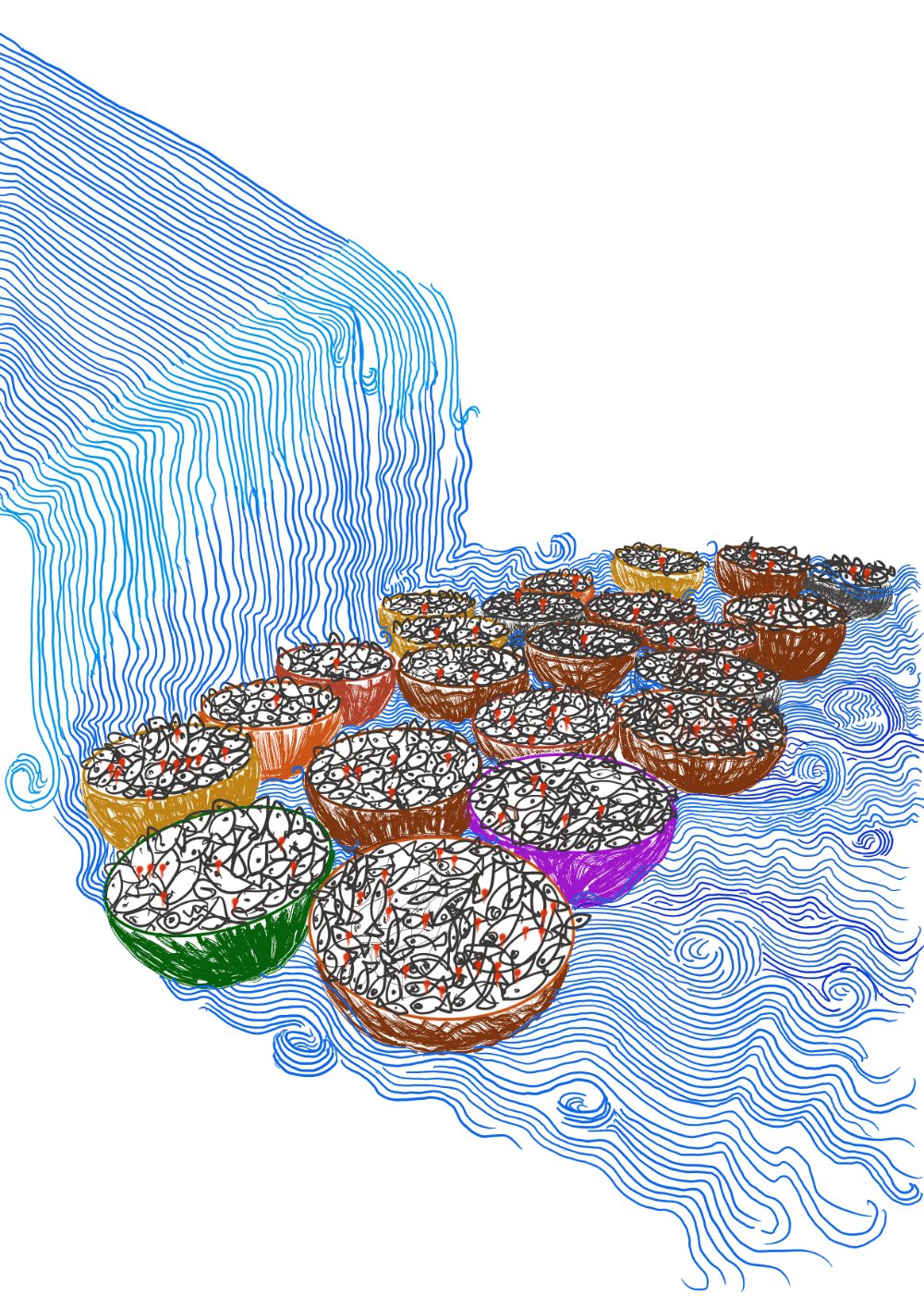


One thought for later: a small MAACH range — feed for the aquarium, food for the kitchen — that could one day help pay for this work. Nothing here is decided, and the fish have not been consulted.
A quick sketch in the brand's own hand-inked style — nothing here is a product yet.
Be told when MAACH opens.
One email, when there is something real to say. If you tell us your district, you help decide where this starts.